
Ultra Violet

Sometimes people ask, “Simon, why purple?”
“Why lasers?”
“Why purple lasers?”
It all started a long time ago in a land far away…literally, I was around 10 and living in central England when I saw my very first ultraviolet lights.
They were mounted on the ceiling of the Atherstone North Middle School auditorium, and I was instantly intrigued by their deep-purple glow. My eyes couldn’t focus on the intense, dark beams, and I kept pausing to stare upward, utterly fascinated by the blurry violet radiance.
I can’t remember which play we were doing, or exactly what grade I was in at the time, but I remember the teachers describing the strange lights that would make our eyes, teeth, and costumes glow.
I already had a healthy (or unhealthy really considering how many times I nearly electrocuted myself or burned down the house) fascination with electricity, but seeing those powerful black lights got me enthralled with nuclear physics (which led to future shenanigans with radioactive materials…but that’s another story). Starting from the short UV wavelengths that our eyes cannot see, going shorter to get x-rays, and shorter still to gamma rays, all of this was just so awesome to my 10-year-old self.
Finding a book entitled “Atomic Physics” in the children’s section of the library, which I’m sure was wildly miss-shelved, helped push my fascination, and subsequent less-than-safe experimentation forward…including demonstrating how to use an old ignition coil my father had given me to create a high-voltage power source, and then shock the heck out of myself.
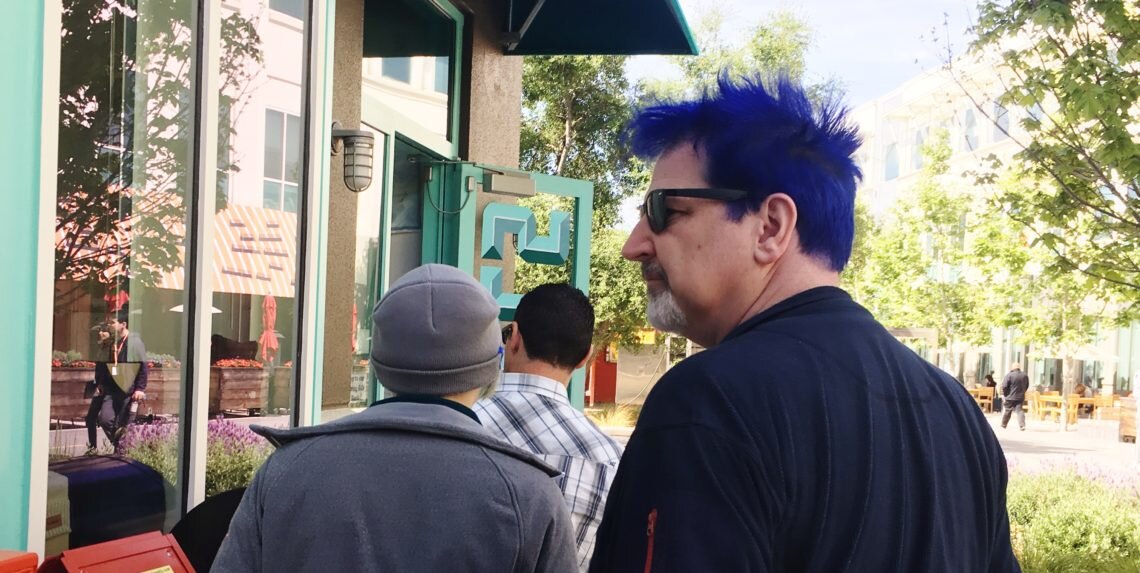
It’s been other colors but I keep going back to purple…the color that started so much
At any rate, I gushed so much to my parents about the super-cool UV lights, my dad gave me the Gro-Lux fluorescent tube from our old aquarium to muck around with. It was an eerie light lavender instead of the deep purple that so mesmerized me, but it was something to experiment with while I saved up to buy my own.
A Tube All My Own
It took me a couple of years, saving pocket change and making money from my paper route, but I finally got to go to Neta Electrics in Nuneaton and order my very own UV fluorescent tube.
The two months it took to arrive felt like forever, and when it did I was deeply disappointed to discover it was a full-spectrum UV tube, without the purple coating that makes a true black light – the light was white, and glowed a pale purplish-blue.
I pushed past the disappointment, because at least it was stronger than the old Gro-Lux, and started right in concocting a circuit I could use to fire up the light without a starter or ballast assembly.
I built a power pack in a black cigarette holder, ran wires down the length, and wrapped exposed copper wire around the prongs at each end of the tube. Then, heeding the warnings that UV is dangerous, I used a sheet of copper to make a housing that wrapped around the tube, leaving only a small strip of light.
After some experimentation, I figured out I could run the tube in cold cathode mode, without the ballast and starter, by dramatically stepping up the operating voltage to double its normal value, ~480 volts, with the copper sheath helping to funnel the electrons around the tube to kick-start the mercury ionization.
It worked!
I was so proud, I took it to school to show my Physics professor, Mr. Perry (who is still one of my greatest inspirations). He, on the other hand, was utterly horrified. He asked about the voltage, boggled at the transformers I’d wired together to first step the power down and then back up, and inquired if I knew the current. I did not, since I’d been too nervous to hook my UV contraption to my father’s Ammeter.
He shook his head, “well Simon, it’s a miracle you’re still alive.”
This commentary did not stop me from further experiments with my UV light, or any of the other devices I rigged up in subsequent years, including convincing the local dentist’s office to give me their expired, unused dental x-ray films so I could check if my home-made x-ray tubes were indeed producing x-rays, or the time my uncased 7,500-volt home-brew laser tube and power supply was accidentally pulled onto my lap while it was plugged in and powered up (miraculously, everyone and everything survived unscathed).
Years Later…
I got several jobs, and increasingly exciting opportunities to play with cool tech stuff and create new things, until one of those jobs moved me to California. There I encountered an unusual store, down a short, hidden hall in the local mall, called Spencer’s Gifts with shelves full of black lights.
Finally, there, sitting right out on a shelf where anyone could buy it with no ordering or waiting, was the deep-purple UV lights I’d been fascinated with since I was 10 years old.
I bought a whole bunch and became that “cool” guy with black lights all over his apartment (side note, I did find they were excellent for luring flies outside after an unfortunate rotting melon left on the countertop while on vacation incident).
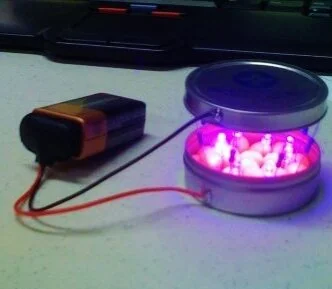
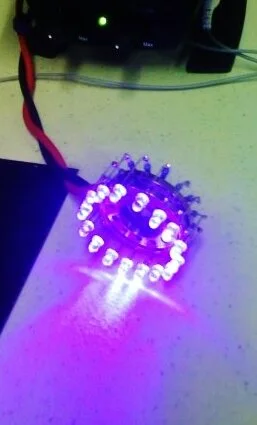
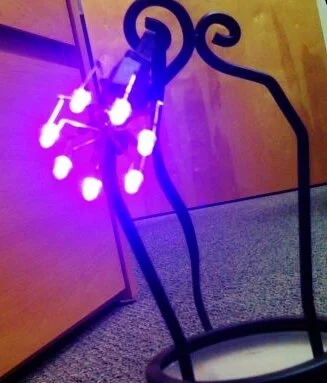
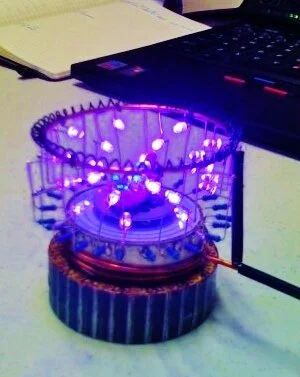
Always fascinated with UV and LEDs and electricity...a few years ago I combined them into UV LED sculptures
Still Purple, Still Lasers
I’ve loved purple and lasers since that day, at 10 years old, when I walked into that auditorium in a little school, in little town in central England, and saw the wonder of dark, UV radiation beaming down.
I’m older, wiser, and can afford better toys now than I could as a 12-year-old with a paper route. Instead of dreaming of purple lasers, I’m having a great time projecting them onto hillsides a couple of miles away.
I freaking love lasers and this was awesome. And, I’m working on creating something pretty cool with this laser and a few other bits and pieces because experimenting and creating new things still captivates me.
So, if you know a kid who’s fascinated or excited by something…give them the Grow-Lux, some sheet copper, or an ignition coil. Give them some batteries, wire, and a volt meter. Heck, give them a HeNe tube laser like the one I dreamed over in the Mapling catalog when I was 12.
Try to ensure they don’t burn down the house, but let them experiment. Let them learn that science is fun, and cool, and awesome, and exciting. Let them be creative and see what they can invent.
You really never know where it might take them.

